
Pallet field guide · entry
2-way vs 4-way pallets
A 2-way pallet accepts forks from two opposite sides. A 4-way pallet allows entry from all four sides—but that label may describe forklift forks, not unrestricted pallet-jack access.
Direct answer
There are really three entry classes to check
Two-way: forks enter through two opposite ends. Partial four-way: forklift blades can enter from all four faces, but notches or bottom boards limit pallet jack access. True four-way: the openings support practical entry from every side for the equipment specified by the pallet supplier.
Do not choose from the words “four-way” alone. Confirm the pallet drawing, the equipment type, fork spacing, wheel path, clearance and the direction in which the pallet will sit in racks or conveyors.
Interactive handling demo
Try the same opening with both tools
Start with a notched stringer. Watch the forklift enter from the side, then switch to the pallet jack and see why it stops.
02 Equipment
03 Approach
One view represents both opposite faces of this build.
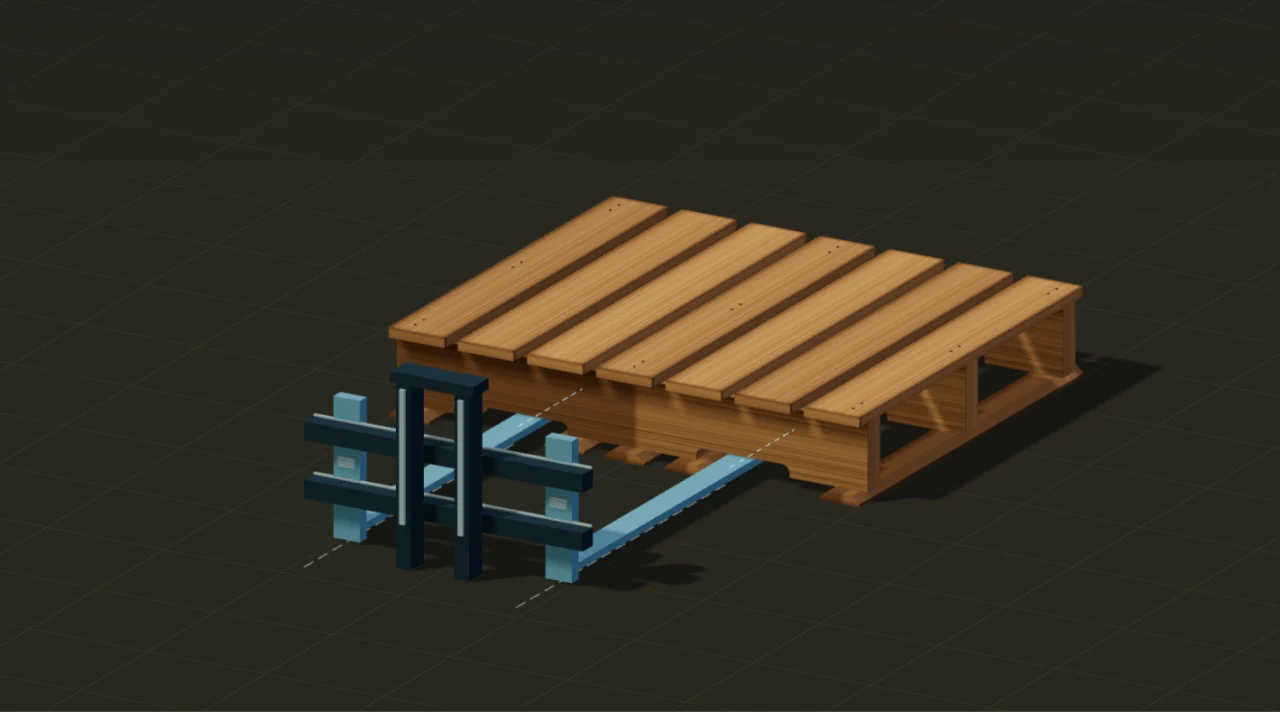 Dashed lines show forks under the deck
Use the comparison below to check forklift and pallet jack access for each build.
These are example builds, not fit tests. Verify fork spacing, opening height, lead-board chamfers and where the load wheels land on the supplier’s drawing.
Comparison ledger
Which approaches work for each build?
Wood pallets have three standard entry classes. Bottom configurations are a separate choice: several bottom layouts can share an entry class, and two block pallets can give a jack very different access.
| Example build | Forklift | Pallet jack | What to look for underneath |
|---|---|---|---|
| Solid stringer | Ends only | Ends only | Solid stringers block both sides. |
| Notched stringer | Ends and sides | Ends only | Forklift blades clear the side notches, but this jack’s wheel assembly does not. |
| Perimeter block | Ends and sides | Ends and sides | A picture frame and center runner leave wheel bays between beveled boards. |
| Three-runner block | Ends and sides | Ends and sides | Open floor lanes at the ends; beveled boards to cross from the sides. |
| Cruciform block | Ends and sides | Ends and sides | Center members in both directions divide the bottom into four wheel bays. |
| Overlapping bottom | Ends and sides | Ends only | Crossboards raise the runners. The square side lead edge stops this jack. |
| Cutout panel | Ends and sides | Ends and sides | Cutouts give the load wheels room to reach the floor. |
| Open-foot block | Ends and sides | Ends and sides | No bottom boards across the wheel paths. |
| Reversible stringer | Ends only | Neither | This full lower deck leaves no open wheel bay at the lift position. |
| Runner skid | Ends only | Ends only | No bottom deck; the open lanes run between the solid runners. |
| Plastic nestable | Ends and sides | Ends and sides | Tapered feet leave open floor lanes from either approach. |
| Plastic three-runner | Ends and sides | Ends and sides | Open floor lanes at the ends; tapered runners to cross at the sides. |
| Plastic perimeter | Ends and sides | Ends and sides | Wheels cross a tapered edge and land in a floor opening. |
Plastic pallets can have similar wheel paths, but molded runners, feet and cutouts vary by model. See the plastic pallet guide for those construction differences.
Equipment check
Forklift forks and pallet-jack wheels need different paths
A forklift inserts thin forks and lifts the pallet directly. A manual or powered pallet jack rolls its load wheels through the pallet opening before lifting. The wheels also need a place to reach the floor at the lift position; a continuous lower deck can get in the way even when the tips fit. A notch can be large enough for a fork while still leaving wood in the wheel path.
That is why a notched-stringer pallet is often described as partial four-way. The side notches improve forklift access, but the open ends are the usual pallet jack approach. Check the drawing before counting on any side entry.
Regional proof
Footprint and shape do not determine entry
CHEP describes its North American 48 × 40 inch pooled wood block pallet as a true four-way design with a full-perimeter base. By contrast, North American notched-stringer pallets with the same 48 × 40 footprint are commonly partial four-way. The plan dimensions alone do not settle the entry question.
Australia supplies an especially useful counterexample: Loscam describes its 1,165 × 1,165 mm Australian pallet as a three-bearer, two-way pallet. A square pallet is not automatically four-way.
- CHEP North America
- 48 × 40 in · block · true four-way
- Classic notched stringer
- 48 × 40 in footprint common · partial four-way
- Loscam Australia
- 1,165 × 1,165 mm · three bearers · two-way
Selection checklist
Choose entry around the actual handling route
- Name every handling device. Include forklifts, walkie riders, hand pallet jacks, conveyors and automated equipment.
- Draw each approach direction. Check the dock, trailer, rack, staging lane and receiving area—not just the first pickup.
- Inspect the bottom. Confirm that wheels and forks have a clear path and that lower boards contact the intended supports.
- Verify clearances. Fork pockets, notches, wheel openings and bottom boards vary by design.
- Keep the rating conditions. Entry does not establish a floor, rack, fork or stacked-load rating.
For an incoming load, record the entry class in the receiving check. For a new purchase, include the equipment and support conditions in the supplier request instead of ordering on footprint alone.
Primary references
Sources and scope
- National Wooden Pallet and Container Association, Uniform Standard for Wood Pallets (2012), §§4.3–4.6 and 5.1.4 — entry classes, bottom layouts, and lead-board chamfers. See Woodpack Global’s resource library for the current edition.
- Toyota Material Handling, The Pallet Guide — open ends versus approaches across bottom boards on three-runner and perimeter block pallets.
- ORBIS nine-foot nestable pallet and Cabka Nest US5 — examples of molded feet and runner layouts. Verify hand-jack access by model.
- U.S. Forest Products Laboratory, Unitizing Goods on Pallets and Slipsheets — public construction and entry classifications.
- CHEP North America pooled wood block pallet — named 48 × 40 inch block design, true four-way entry and full-perimeter base.
- Loscam Australian wooden pallet product sheet — 1,165 × 1,165 mm, three-bearer and two-way description.
- ISO 445:2013, Pallets for materials handling — Vocabulary — public catalog record; the full vocabulary standard is paywalled.
Checked . Product designs and supplier terminology can change; confirm the current drawing before purchase or acceptance.