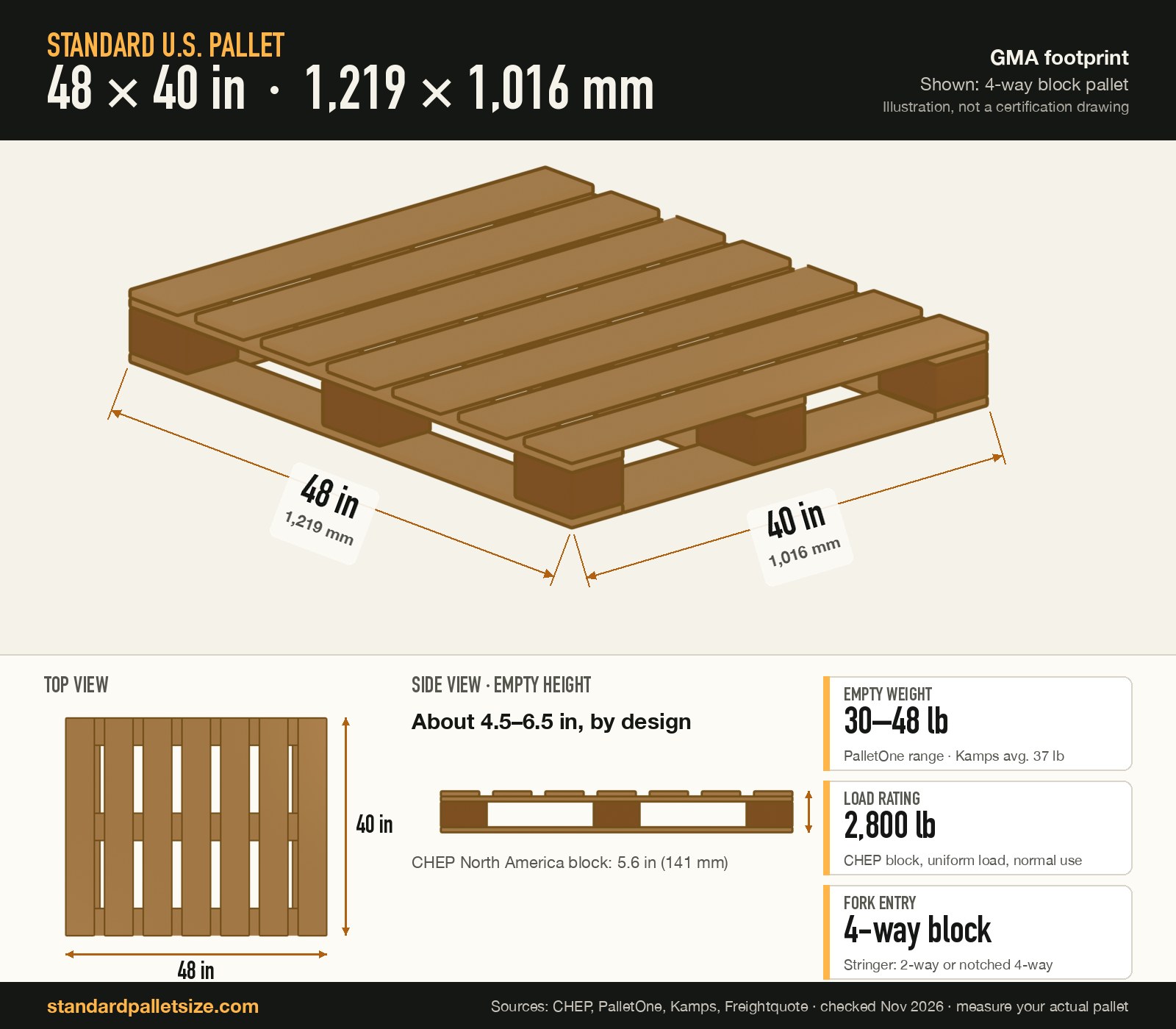
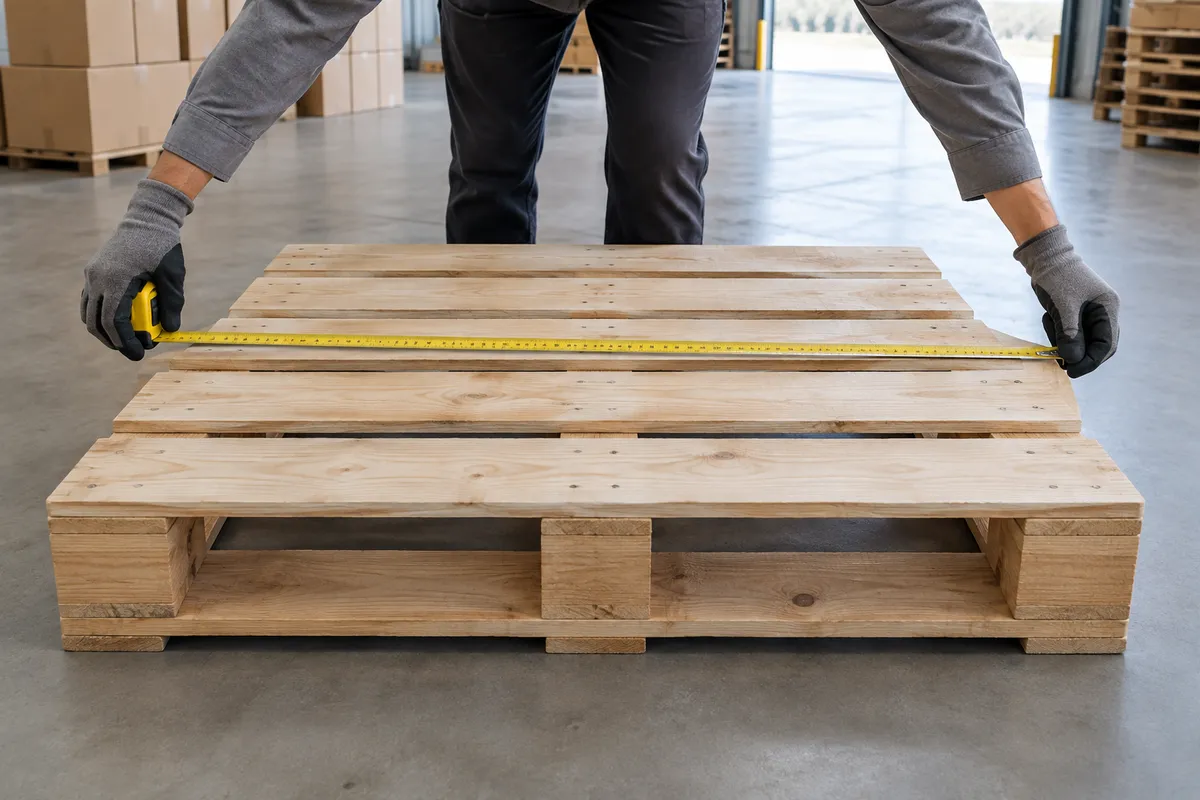
The standard U.S. pallet measures 48 × 40 inches across the deck. Often called a GMA pallet, this footprint is common in North American grocery and retail distribution.
Footprint, empty height, weight, load rating and fork entry for the common U.S. pallet. Free to share with a link back.
Illustration of a 4-way block pallet, not a certification drawing. Sources: CHEP, PalletOne, Kamps and Freightquote, checked November 14, 2026. Measure the pallet you’ll actually use.
Pallet dimensions by region
Use these published footprints to compare sizes or start a load plan. Empty height is listed for the specific pallet shown in each row.
Footprints follow the source’s length × width order, and converted units are rounded. EPAL lists 800 mm as the Euro pallet’s length. CHEP lists 1,200 mm as its UK pallet’s length. Check the product drawing when fork-entry direction matters. Source pages checked November 14, 2026.
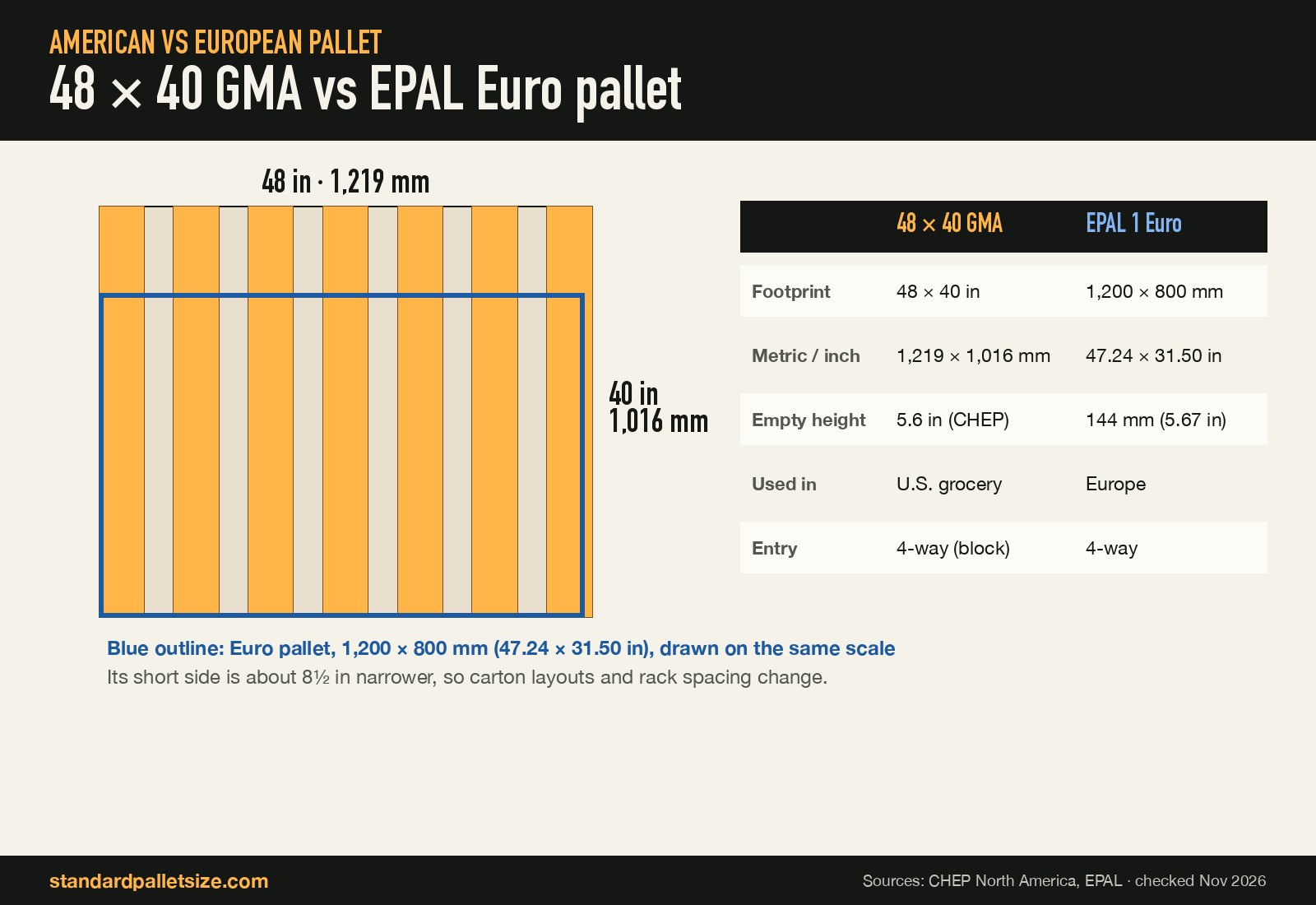
GMA vs Euro pallet on the same scale. The Euro pallet’s short side is about 8½ in narrower.
Other North American pallet sizes
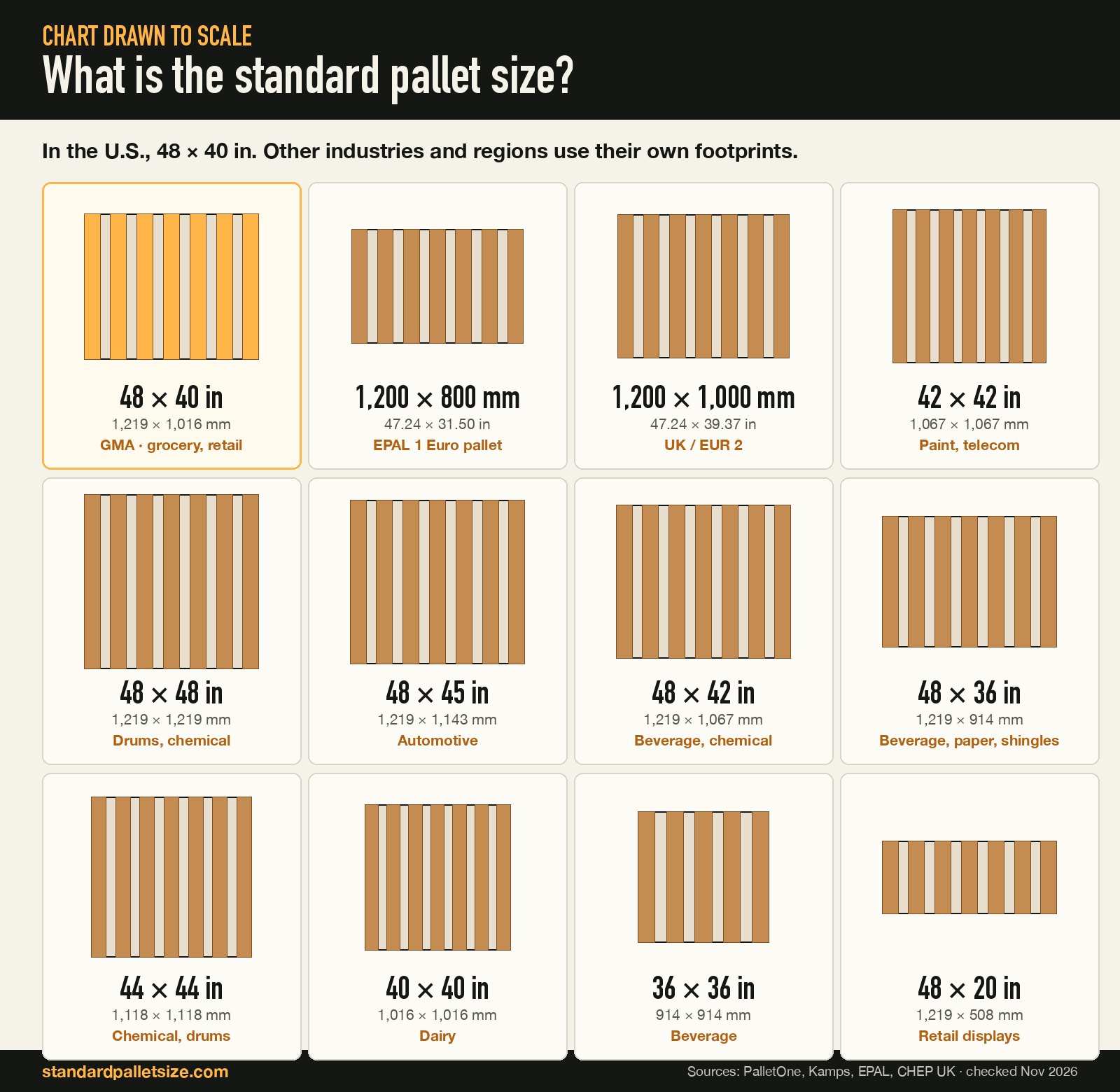
48 × 40 is the most common U.S. pallet. PalletOne says it makes up over 30% of pallets used in the United States, and Kamps says around 30% of new wood pallets built in the U.S. Other industries settled on their own footprints.
Footprint
Typical uses
Reported by
48 × 48 in1,219 × 1,219 mm
Drums, chemical
Kamps · PalletOne
42 × 42 in1,067 × 1,067 mm
Paint, telecom
Kamps · PalletOne
48 × 45 in1,219 × 1,143 mm
Automotive
PalletOne
48 × 42 in1,219 × 1,067 mm
Beverage, chemical
PalletOne
48 × 36 in1,219 × 914 mm
Beverage, paper, roofing shingles
PalletOne
44 × 44 in1,118 × 1,118 mm
Chemical, drums
PalletOne
40 × 40 in1,016 × 1,016 mm
Dairy
PalletOne
36 × 36 in914 × 914 mm
Beverage
Kamps · PalletOne
48 × 20 in1,219 × 508 mm
Retail
PalletOne
Standard pallet sizes, drawn to scale. Free to share with a link back. Sources: PalletOne, Kamps, EPAL and CHEP UK. Download the printable chart (PDF).
Typical uses are what pallet makers report, not a standard. Your customer or carrier may ask for a different size. Sources: PalletOne (September 8, 2024) and Kamps (June 22, 2020), checked November 14, 2026. Converted units are rounded. Euro and other metric pallets aren’t interchangeable with these inch footprints in tight racking or automated storage, so check the receiver’s spec.
48 × 40 in · Example column stack
See the stack before you build it
Enter your pallet and carton measurements. The load planner lays out each layer, counts the cartons and totals the loaded height.
GMA stands for Grocery Manufacturers Association. The name is still used for the common U.S. grocery footprint. A wood stringer pallet carries its deck on long beams. A wood block pallet uses spaced blocks and commonly provides fork entry on four sides. Both can share the same footprint. See the pallet bottom types gallery.
Empty pallet height
Kamps gives about 4½ in for a stringer example. PalletOne lists 4¾ in in its GMA guide, and Freightquote gives about 6½ in as general guidance. CHEP lists 5.6 in (141 mm) for its North American block pallet. Measure from the floor to the top of the empty pallet before you estimate how many carton layers fit.
Kamps lists 37 lb as the average in its 48 × 40 chart. PalletOne gives 30–48 lb for standard wood pallets. Weigh the pallet you’ll use and include it when checking gross weight.
CHEP specifies 2,800 lb for its North American wood block pallet with a uniformly distributed load in normal operation. Ask your supplier for the rating for your pallet and how you’ll support it, such as on a floor, in a rack or on forks.
Measure edge to edge across both sides of the deck. For an existing load, also measure the widest points of the load, including any carton overhang or wrap. Use those actual dimensions when they differ from the preset.
Ask your receiver for its accepted pallet footprint, maximum loaded height and gross weight, and allowed overhang. Confirm which sides your equipment can enter and check the pallet’s rating for the way it will be supported.
If the receiver specifies a pool, confirm the accepted operator before loading. Buying pallets outright gives you control over their reuse. Pooled pallets remain the operator’s property and are returned through its network. Check the markings before reusing or disposing of a pallet. CHEP and PECO provide return instructions.
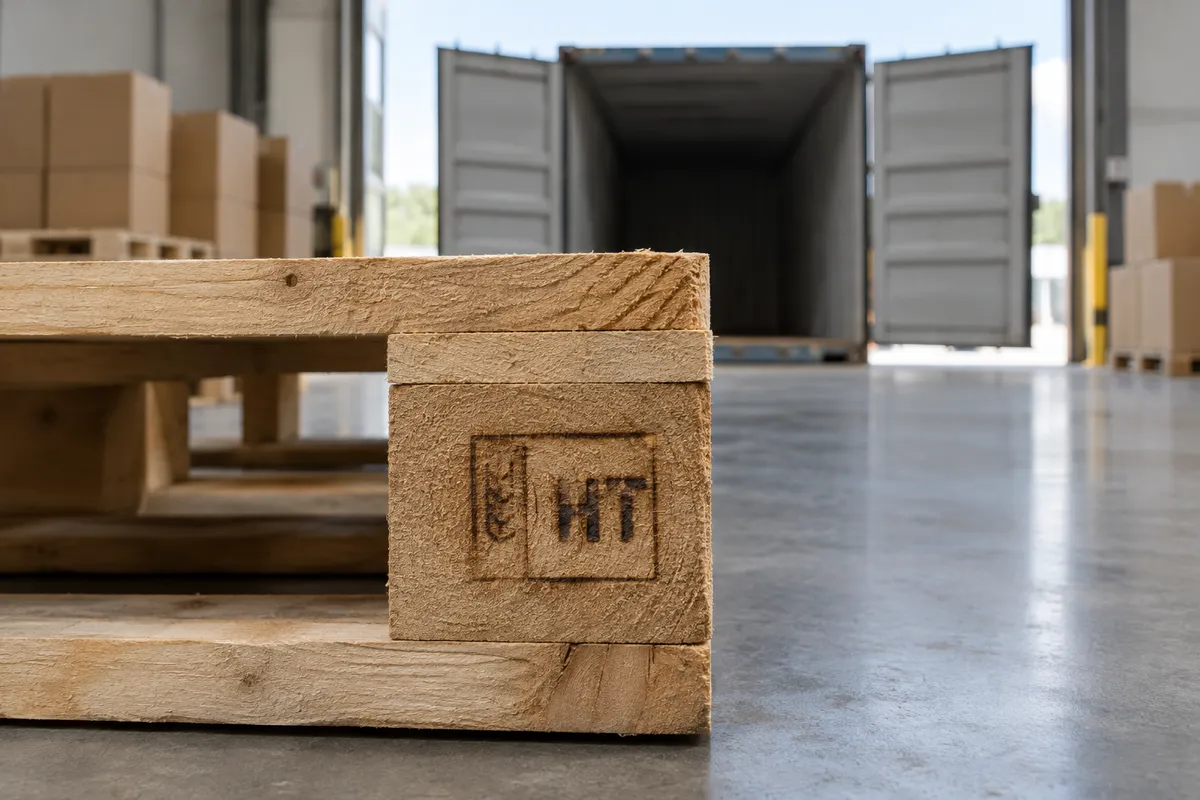
Many destinations require solid-wood packaging to comply with ISPM 15. Check the destination requirements before shipping. When compliance is required, use packaging with the official treatment mark, which identifies treatments such as heat treatment (HT).
Is a 40 × 48 pallet the same size as a 48 × 40 pallet?
They describe the same rectangular footprint if you turn it 90 degrees. For handling, verify which edge has the fork openings and whether the pallet suits your rack or lift equipment.
What is the difference between a GMA pallet and a Euro pallet?
The common U.S. grocery footprint is 48 × 40 in (1,219 × 1,016 mm). An EPAL 1 Euro pallet measures 800 × 1,200 mm. You’ll also see it written as 1,200 × 800 mm. Its shorter side is about 8½ inches narrower than the U.S. pallet’s short side. Rerun the box layout when switching between them.
How do I measure the height of a loaded pallet?
Measure from the floor to the tallest point of the full load, including the pallet and anything above the top layer of cartons. Use that total when checking a receiver’s height limit.
How many boxes fit on a 48 × 40 pallet?
Start with the outside dimensions of a packed carton. Rotating the carton on its base may change how many fit per layer. Empty pallet height, carton height and the shipment’s height and weight limits determine how many layers you can use. Try the box layout calculator.
How do I keep cartons within the pallet footprint?
Start with the measured deck and the dimensions of a packed carton. Try both orientations and check that your outer cartons stay inside all four edges. If a row extends past the deck, rotate the cartons, use fewer, or choose a larger pallet your receiver accepts. After wrapping, measure the widest points of the full load again. FedEx recommends avoiding overhang because it leaves carton edges exposed to damage. FedEx pallet packing guidance.